What does the Marketplace Optimizer module do?
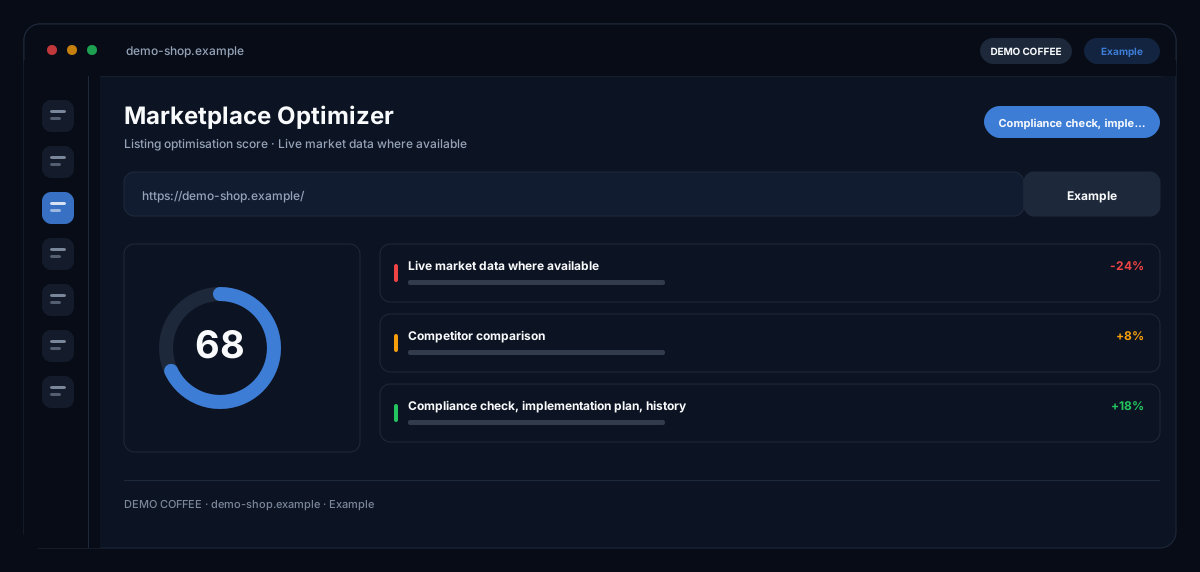
The ecomDNAI Marketplace Optimizer scores an existing listing against the rules of exactly the marketplace you choose first: Amazon, Zalando, ABOUT YOU, OTTO, eBay, bol, Cdiscount, Allegro, Galaxus, Kaufland or another one. The result comes in three parts (what already works, what you should improve, what else you can do), with live market data on Amazon.
You choose the marketplace first, then enter the URL of a product page or a store. The listing is scored against the rules of exactly that marketplace: the module measures title length, image count, description and EAN directly on the page. The result comes in three parts: what already works, what you should improve and what else you can do. On Amazon, real market data feeds in, and on request the module checks your copy against Amazon's rules.
How it works
- Choose the marketplace, then enter the URL of the product page or store
- Add target audience and goal; on Amazon, optionally enable the content compliance check
- Start the analysis: three-part result and implementation plan
What you get
- Optimisation score and measured rule checks
- Result: all good, improve, do additionally
- Live market data (Amazon) and competitor comparison
- Compliance check (Amazon), implementation plan, history
Typical use cases
An Amazon listing losing rank
You enter the product URL and your goal, such as raising the conversion rate, lowering ACoS or winning the Buy Box more often. The marketplace score rates title, bullets, description, images and A+ content; live market data shows rank, price and demand. Up to five competitors provide the comparison.
Checking an offer on bol, Allegro or Kaufland
You choose the marketplace and paste the product URL. The module measures title length, image count, description and EAN on the page, compares them with that marketplace's rules and shows in the result what works, what to improve and what else you can do.
Finding Amazon rule breaches before a block
Content compliance checks title, bullets, description, images and A+ content against Amazon's rules and, on request, writes compliant titles and bullets. You tag image types so missing ones are found; implementation goes to the A+ module or the image generator.
Who it's for
Sellers and brands with listings on Amazon, Zalando, OTTO, eBay, bol, Allegro, Kaufland and other marketplaces, e-commerce teams with many products and agencies running marketplace accounts for clients. The module scores and plans; the listing itself is changed in the marketplace's seller portal.
Frequently asked questions
Which marketplaces are supported?
Amazon, Zalando, ABOUT YOU, OTTO, eBay, bol, Cdiscount, Allegro, Galaxus and Kaufland, each with its own rule book and measured checks; other marketplaces such as Etsy by URL with a general assessment. Live market data (rank, price, demand figures) is available for Amazon.
What does the three-part result mean?
At the top you see values measured on the page, for example the title length compared with the marketplace's limit. Below, the audit sums up what already works, what you should improve (with reason and suggestion) and what else you can do.
What does the compliance analysis check?
On Amazon it checks title, bullet points, description, images and A+ content against Amazon's rules, with a compliance score and, on request, compliant titles and bullets. On the other marketplaces the audit measures the rules itself and names deviations in the result.
Where does the market data come from?
From a live lookup of the marketplace at the time of the analysis: rank, price and demand figures come from Amazon, not from the model. The module states what an analysis is based on.
Is the history kept?
Yes. Audits and plans stay in the history until you delete them; all plans can be viewed together. A new audit shows whether the score has moved.
What does an audit cost?
Audits, the compliance analysis and compliant copy are billed in credits, through a plan or pay-as-you-go; the module shows what a step needs before you run it. The price is the same for every marketplace.